I seem immersed in England and life there right now. I am coming to the end of 30 CDs of unabridged Dickens, as Bleak House finally finishes after months of commuter listening. I am ten books into a 15+ series of fiction set in an English village. My family history quest has me hopping all over the country with ancestors seemingly in every part. And my co-worker Kintara is busy blogging about her family who are holidaying there for four weeks! Even as I write, Midsomer Murders is keeping me company! Oh, and my daughter Melissa hopes to visit next year for a wedding!
If a bucket of money fell from the sky, I would be off with her like a shot. Melissa and I have a shared interest in English history, folklore, geography and scenery. We could quite easily drive from Lands End to the border and beyond - and lets throw in Wales, Scotland and Ireland while we are there, because they hold just as much appeal!
Living in a country where even the oldest of old buildings cannot be more than the 200 or so years of white settlement; where even my convicts arriving in 1818 can still only mark 7 generations, it is hard to comprehend the sheer age of England and the rest of the UK and Europe. As a fan of Edward Rutherford, who writes immensely detailed histoicral novels tracing families through time, I have deep interest in all the stages of British history. Finding genealogy that flows back 30+ generations, with the Norman Invasion coming to life as suddenly names change and watching the families living through times of war, plague and more, just increases the wish to visit as many pieces of the puzzle as I can.
But for now, I can only watch on from the other side of the planet.
I am struggling to get into the season this year. I think it is mostly because time has flown too quickly for me in 2011 and I don't feel ready for the end-of-year celebrations and reflections. I am frustrated by what I haven't done this year, hamstrung by invasive health issues. A black cloud of depression makes it hard to reflect anything, even wonderful, positive experiences.
So the festive season perhaps feels like one more thing I am having to modify and I resent that. This has always been a favourite time of year, full of traditions which bring my close family even closer. Even though my children are now all adults, there is no sign of them scaling back on childhood rituals - they are, in fact, even more determined to keep them going.
This week we made our annual trek to the Christmas Tree Farm to select our tree. Rather than a leisurely day trip followed by trimming the tree and decorating the house, it was a window of opportunity at the end of my working day - just an hour between my returning home and the tree farm closing for the day. This due to clashing work timetables making family time on weekends impossible. Despite this, or perhaps because of it, all three off-spring made the most of that time and smiled as they selected two trees: one for the family home and one for Melissa's. Kaitlyn and Ashley decided not to get a tree this year as their rental home has been put on the market and they are looking to move.
Arriving home, I just wanted to crawl into bed and sleep. It had been an especially big day: the builders had finally arrived at the office to commence our long-awaited re-fit and Kieran had been allocated to receive the delivery of our new mattress at home, which needed unwrapping and the bed re-made before I could crawl under the doona anyway. So, we compromised - the tree was mounted on its stand by Kieran, watered and left standing bare, like a lady waiting to be dressed! She had to wait til I came home from work the next day. Kieran and Kaitlyn went to Melissa's house to help her get her own tree standing and decorated, so my little helpers were away in any case. Rodney had been away all week for work.
So Thursday, Kieran put the lights in place and I hung ornaments. We made the "annual dash to Big W for ornament hooks and light globes we could have sworn we had extras of the year before" and then Melissa came around to get her share of the globes for the extra lights I had passed on to her. I set up my Willow Tree Nativity and Kieran hung the card holder, on which I hung the first card received - the one that each year is a celebration in itself, a hand-made creation from an old friend. Yet, still, I couldn't feel in the season. The remainder of decorations sat in their boxes for another night. I finally got back to them on Saturday, yet as I write on Sunday, boxes remain.
As I have throughout this year, I am trying to put it in perspective: in the course of my life, I can look back and know that most years I greeted these tasks with delight and will again. 2011 is a blip that will fade into memory and the future will bring better times. Just as my health dips down, it will rise up and my activities will be less restricted by pain and fatigue.
And those boxes will still be there tomorrow.
(There was intention to photograph the completed tree to adorn this post, but taking it just seems like too much effort in itself right now. More evidence I am truly not myself.)
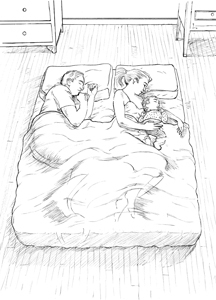
Bed-sharing is the practice of an infant sleeping in the same bed as its mother.
Co-sleeping is the practice of an infant sleeping in the same room as its mother.
Since time immemorial, bed-sharing has been the normal practice of mothers around the world. Indeed, the majority of the world continue to practice bed-sharing. I practiced bed-sharing with all three of my now-adult children. My mother was found by a nurse with me asleep beside her in hospital. It is nothing new!
So why is it now an issue of fear-mongering from coroners and other health professionals around the world? Take, for example, this appalling poster campaign recently released in the US:
I think this is a heartless way to highlight ANY health campaign and can only imagine the outrage if such images were used to highlight the health risks of using infant formula instead of breastfeeding.
Coincidentally, just as these images were making news in the blogosphere, this equally emotive image also appeared in my news feed:
Regardless of decisions consiouslly made by parents, something like 25% find themselves sleeping with their baby at some stage. Therefore, campaigns which highlight potentially high-risk circumstances make more sense than those designed only to frighten parents. An example is the brochure "Is your baby sleeping safely?" which is available on the website of the Australian Breastfeeding Association and which I regularly give to parents seeking information at the Breastfeeding Centre where I work.
In 2010, the South Australian Coroner issued strong warnings against bed-sharing, based on a review of five cases of sudden death in infants sleeping with their parents. I sought out the report online and read it, distressing as the cases were, and discovered that 4 out of 5 cases were instances of blatantly unsafe bed-sharing practices: in fact, some involved sleeping with an infant on a couch or arm-chair, not a bed at all.
Today, the Victorian Coroner has been quoted making similar warnings.
In the first Australian study of its kind, the Victorian Coroners Prevention Unit recently found that of 72 infant deaths reported between 2008 and 2010, 33 were of babies who had slept on the same surfaces as an adult.
Now, look at those numbers and imagine if that prompted a campaign against babies sleeping in cots - after all: 39 out of 72 babies were NOT sleeping in bed with their parent!
Much research has been done to demonstrate the safety of bed-sharing when practiced by breastfeeding mothers who are non-smokers and not affected by drugs or alcohol, which surely should be the standard we should be aiming for.
In fact, bed-sharing enables successful breastfeeding AND enhances safe sleeping in the infant and mother. the work of Dr James McKenna is recognised for the SAFE bed-sharing guidelines which maximise the benefits and reduce the risks. It is such guidelines that coroners and other health professionals should be highlighting:
Safe Cosleeping Guidelines
Guidelines to Sleeping Safe with Infants:
Maximizing the chances of Safe Infant Sleep in the Solitary and Cosleeping (Specifically, Bed-sharing) Contexts, by James J. McKenna, Ph.D. Professor of Biological Anthropology, Director, Mother-Baby Sleep Laboratory, University of Notre Dame.
Below I have summarized and highlight some of the issues to be concerned with as you make your own decisions about where and how your infant should sleep.
What constitutes a "safe sleep environment" irrespective of where the infant sleeps?
Safe infant sleep begins with a healthy gestation, specifically without the fetus being exposed to maternal smoke.
Post-natally safe infant sleep begins especially with the presence of an informed, breastfeeding, committed mother, or an informed and committed father.
Infants should sleep on their backs, on firm surfaces, on clean surfaces, in the absence of smoke, under light (comfortable) blanketing, and their heads should never be covered.
The bed should not have any stuffed animals or pillows around the infant and never should an infant be placed to sleep on top of a pillow.
Sheepskins or other fluffy material and especially bean bag mattresses should never be used. Water beds can be dangerous, too, and always the mattresses should tightly intersect the bed-frame Infants should never sleep on couches or sofas, with or without adults wherein they can slip down (face first) into the crevice or get wedged against the back of a couch.
Bed-sharing: It is important to be aware that adult beds were not designed to assure infants safety!
Bottle-feeding babies should always sleep alongside the mother on a separate surface rather than in the bed.
If bed-sharing, ideally, both parents should agree and feel comfortable with the decision. Each bed-sharer should agree that he or she is equally responsible for the infant and acknowledge that the infant is present. My feeling is that both parents should think of themselves as primary caregivers.
Infants a year or less should not sleep with other children siblings -- but always with a person who can take responsibility for the infant being there;
Persons on sedatives, medications or drugs, or is intoxicated - -or excessively unable to arouse should not cosleep on the same surface with the infant.
Excessively long hair on the mother should be tied up to prevent infant entanglement around the infant's neck -- (yes, it has really happened!)
Extremely obese persons, who may not feel where exactly or how close their infant is, may wish to have the infant sleep alongside but on a different surface.
It is important to realize that the physical and social conditions under which infant-parent cosleeping occur, in all it's diverse forms, can and will determine the risks or benefits of this behavior. What goes on in bed is what matters.
It may be important to consider or reflect on whether you would think that you suffocated your baby if, under the most unlikely scenario, your baby died from SIDS while in your bed. Just as babies can die from SIDS in a risk free solitary sleep environment, it remains possible for a baby to die in a risk-free cosleeping/bed sharing environment. Just make sure, as much as this is possible, that you would not assume that , if the baby died, that either you or your spouse would think that bed-sharing contributed to the death, or that one of your really suffocated (by accident) the infant. It is worth thinking about.
Aside from never letting an infant sleep outside the presence of a committed adult, i.e. separate-surface cosleeping, I do not recommend to any parents any particular type of sleeping arrangement since I do not know the circumstances within which particular parents live. What I do recommend is to consider all of the possible choices and to become as informed as is possible matching what you learn with what you think can work the best for you and your family.
I have been a family historian for many years but it has taken a backseat lately due to other commitments and pursuits. However, contact by several people querying relationships prompted me to upgrade my Family Tree Maker software so I could open my files on my new laptop, which runs Windows 7. I also fired up my Ancestry.com account.
More and more people are joining Ancestry.com and that means you get a lot more hints as the program finds people who match those in your tree. It is great fun clicking on the waving leaves that attach themselves to your family members and confirming those who match. Before you know it, further generations are added on and time tumbles away before your eyes.
Well, I was quite giddy to find that a previous brick wall - my paternal grandmother's family line Fenn - crumbled before my eyes and missing links appeared, leading me back to the original name Fiennes, then de Fiennes and time was marching backwards toward the Norman conquest of England! And then beyond even that. Before my eyes, family history crossed into world history and I was faced with my pedigree running right back to the Emperor Charlemagne! How exciting to be one of the 10% of the population who are descended from this historical figure! My kids were quite impressed and my son fired up a world history timeline on the internet and started plotting the family names against historical events.
A day or so later, I asked him what could "top" an Emperor and Pope. I asked if a Saint would do? You see, I had stumbled across another famous connection, this time on my mothers maternal line, where just a few generations back and to the side, who should appear but Mary MacKillop, Australia's first Saint! Turns out, she is my second cousin, four times removed! A newly-found third cousin who had connected with me via Ancestry.com just a few weeks ago confirmed this was known in her family line and there were stories of her giving aid to family members!
Only a couple of years ago, I visited Temora cemetery, where my great-great-great grandfather Hugh Lindsay Sinclair is buried, alongside his wife, Mary McDonald.
Hugh Lindsay Sinclair 1815 - 1906
It is Mary McDonald's family that includes Mary Helen Maria Ellen MacKillop, daughter of Alexander MacKillop and Flora Hannah McDonald - "my" Mary and Flora were first cousins! Mary Helen Maria Ellen went on to become Mother Mary MacKillop who was recognised as a Saint in 2008, just a couple of months after I had seen those graves in Temora.
There are a whole lot of family photos here on the official website!
Isn't it amazing what you can find out with a few clicks of the keyboard from the comfort of your own home?
If you express your breastmilk in the early days after your milk
comes in, you will probably get more than your baby needs for a feed – indeed,
you might feel you have enough milk for all the babies in your ward! You head
home confident that expressing is quick and easy and start to plan for the
extra freezer you will buy to store all that expressed breastmilk in.
So you are really disappointed when you try expressing for
the first time after the early postnatal period and only get a few mls for your
effort. If you are expressing to have a supply of milk for your return to work
or a special occasion away from your baby, you will probably start to panic and
worry that you need a different (better) breast pump or you have a poor milk
supply.
Guess what? Everything is okay!
Once breastfeeding is established and milk production is in
sync with the baby, the breasts no longer stockpile excess milk, just in case
it is needed. Instead, baby’s feeds are made-to-order, with just a little spare
kept on hand in case it is needed.
So, instead of you having an endless supply you can call on
whenever you want – like an unlimited credit card – now you are living a
credit-free life where you need to save up for what you want. Just like the
financial world, now you need to think about a savings plan and how much you
need to put away each week to meet your goals.
You might like to think of these first few goes with your
breast pump or hand expressing as practice sessions, where you learn the tricks
and tips to maximise your expressing skills. Then, once you have worked it all
out, you can start banking your milk towards the future. Most mothers find it
takes about 15-20 minutes after the let-down to pump each breast and they can
collect more milk earlier in the day than in the afternoon or evening.
If you just want some breastmilk in the freezer for a “rainy
day”, then you can just express whenever you have a little time between feeds.
But if you have a set goal in mind – enough milk for the first week or two back
at work; two or three feeds to cover your sister’s wedding day or one feed each
week while you are at yoga class – then you will need to do a little maths and
work out a plan.
Say you find you average about 20-50mls each time you
express and you work out your baby will need about 70mls each feed, then you
will know it takes you roughly two sessions to save up one feed. A few practice
runs with your partner or other caregiver feeding your baby EBM will help you
estimate how much you might need. But remember breastfed babies take varied
amounts at each feed and you can never accurately guess an exact amount, so
divide your “piggy bank” into small amounts of frozen milk until you get an
idea of what he needs. You can buy Breastmilk Freezer Trays which hold 30mls
per section and this is a good amount to work with.
So, just as you did when saving for your childhood
hearts-desire, get in the habit of putting a little bit away on a regular basis
and you can be confident you will have enough when you need it.
See also: ABA booklet
Expressing & Storing Breastmilk $5.00
I have had a really BLAH couple of weeks - the normal come-down after a holiday, plus a misery-making cold and a visit from the MS fatigue fairy.
However, I could not resist the draw of the sunshine today, as I left my MS support group at 2pm, the afternoon stretched ahead and there was only one thing for it - I drove home, grabbed the dog and our assorted walking gear and headed to the beach.
We are so blessed to live in a beach-side town, on the edge of the metro area. While we don't live within (reasonable!) walking distance, it is only a few minutes drive and we are there. I often fantasise about a beach-side cottage, where the waves lap gently only a few steps from the door - but then we have a massive storm like we did this week and I am thankful we live up the hill!
Celebrating the final two weeks before the doggy curfew kicks in next month, Molly and I were able to enjoy the daytime beach, along with visitors making a day of it. The sand was host to lots of those little tent shelters and just a couple of umbrellas, while most people bared their lily-white winter bodies to the full sun. The boats were out at the yacht club, the jet skis disturbed the peace at Olivers Hill and small children shivered in wet towels - the water looks inviting, but it is still early in the season for full immersion - although the usual teenage boys and young men were doing their macho act in the cold.
We stopped for gelati - Molly and I share, to the wonder of passing children "That dog is eating ice cream!!!!" and then continue our walk. We are stopped often - "Can I pat your dog?" - and Molly paddles up to her self-imposed tide line. The skeleton of a freshly-filleted Schnapper tempts her in the shallows, but not enough to get Too Wet!!!
The beach is my happy place and the sunshine, salt water and sea air work together to wash away the BLAH. It is time to go home, even though Molly actions a Sit Down when we reach the point where she realises we are leaving, clearly not ready to leave. but I am, so we do.
On my recent trip, I was able to talk to my uncle about a family story of which I had little detail. On my return, I received his written account, which I share here.
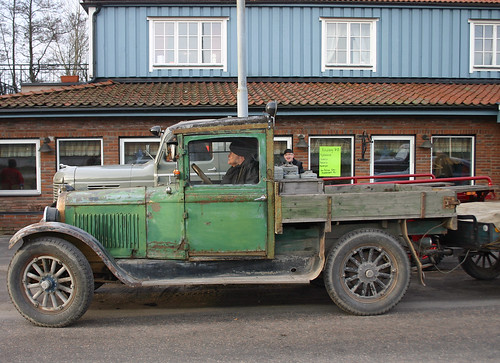
"My father Harry had two '27 model Dodge cars that they had cut down into utilities, the utes were always driven by George as Dad had an accident with a car and lost his nerve. One day in 1950 they had a social trip to Ilabo where they were to have a few beers and a yarn to the stock and station dealer. they swapped rego plates on those two utes to which one was running best at the time, on the way home they were driving beside the railway line. About three kilometers out of Ilabo they made a sharp right hand turn to cross the line. As the gates at the crossing had been incorrectly left open, George kept going straight and the Riverina Express 38 classic locomotive doing 100kph and the canvas hooded ute hit the connecting rods on the main driving wheels. This swept the ute between the 38 loco and the gate post. A gap of about 1.2 metres. As the gatepost was made of two pieces of railway line the car was smashed to bits. The Express was put out of action and when it stopped the guard's van was level with the gate. the guard stepped down from the train, saw Dad standing near the gate with very little left of the car. The guard asked "are you alright?" "Yes" Dad replied "but I can't find my brother" so they had a look about and found George in the grass looking for his pipe. A piece of the car went through the gatekeepers water tank, spilling most of his only water supply, another went through the window of the house which was over 100 metres away. Their injuries were a grazed nose to dad and a cut to George's right elbow tendon. This injury caused his little finger to wither away, this never bothered George as he never went for any treatment." Alan Buckley 2011
Just a short while before my visit, Uncle Alan had found parts of the car wreckage at the site, more than 60 years after the event! He gave me a piece to bring home.
Curious, I Googled both the car and the train:
You can see from this photo of a similar car the section that my uncle is holding in the previous photo!
So, now the story is told - although I am sure both George and harry would have a lot more to add!